
Specialty coffee has reshaped how coffee is produced, marketed, and consumed.
If you visit a café today, you'll probably notice farm names, processing methods, and tasting notes highlighted on the menu. Coffee isn't just called 'strong' or 'smooth' anymore. Now, it's described as floral, juicy, honey-processed, anaerobic, washed, or grown at high altitude. Prices have changed too—a bag that used to cost a few dollars now sells for twenty or more.
To many consumers, this represents progress. Better coffee should lead to better outcomes across the supply chain, especially for the farmer who grows it.
Yet a fundamental question remains unresolved.
Does specialty coffee help farmers?
The short answer: not always.
While specialty coffee is often marketed as a more ethical, higher-paying alternative to commodity coffee, the reality is more complex. Higher retail prices don’t automatically translate into higher incomes at the farm level, and in many cases, the biggest gains happen further down the value chain.
This article breaks down how value is distributed in specialty coffee, why premiums don’t always reach producers, and what needs to change for farmers to truly benefit.
What “Specialty Coffee” Promises Farmers
Over the past decade, specialty coffee has presented itself as a story of progress. Quality has improved, retail prices have risen, ethical language has become more visible, and relationships across the supply chain are often described as closer and more intentional.
But at the same time, the market shows that this progress is happening in a tighter environment. Retail prices keep rising, and consumers know more than ever, yet the specialty coffee market is getting crowded, especially in established import markets. With so many new roasters and cafés, it's harder to stand out, and high business turnover shows how tough the competition is. In many established markets, about 62 percent of specialty coffee shops close within five years, showing how challenging and crowded the industry has become.
Industry experts now see this as a structural change, not a decline. Growth in specialty coffee is mainly driven by premiumization, not by more people drinking coffee. The market has settled into a new normal, with higher prices, tighter margins, and ongoing supply-chain issues, but it's still commercially viable.
You can see this change in established markets like the United States and the European Union. People still drink a lot of coffee, but growth has slowed compared to the past. Market saturation, high per-person coffee consumption, and broader economic pressures have made it harder for the market to grow quickly.
Curious how these dynamics play out in genuine sourcing relationships?
At Solai Coffee, we work directly with farms to ensure our prices reflect the real costs of production, not just market trends.
Learn more about Solai farmers
Slowing growth in developed importing markets
In major importing regions like the EU and the US, coffee consumption growth has slowed. In the European Union, coffee consumption fell by about 5.6 percent in 2023, the most significant decline since the 2008 financial crisis. Green coffee imports to Europe also dropped by nearly 10 percent, reflecting the impact of higher living costs and a shift to using existing stock rather than buying more.
Several factors are behind this slowdown. High coffee consumption per person and flat or shrinking populations make it hard for the market to grow quickly. Still, demand hasn't disappeared. While sales of regular ground coffee have dropped in the US, people are buying more specialty coffee, especially premium espresso drinks. This shows that value growth now comes from higher prices and better positioning, not from selling more coffee overall.
Emerging markets as drivers of global growth
While growth has slowed in traditional importing regions, coffee consumption is rising quickly in emerging markets, especially in Asia and parts of Latin America. These areas now account for a larger share of global coffee demand.
China is the best example. Coffee consumption there has grown by more than 150 percent over the past decade. In 2023 alone, the number of coffee shops rose sharply, indicating that café culture is becoming the norm for city dwellers. Similar trends are occurring in Vietnam, Indonesia, and the Philippines, driven by younger populations, higher incomes, and greater urbanization.
These markets have long-term growth potential, but their pricing works differently, and they do not yet match the buying power of established specialty markets in Europe and North America.
You may also like: Shifting Priorities in the U.S. Coffee Market
Key factors shaping coffee consumption patterns
Several forces are shaping how consumers and businesses respond to the current environment:
- Elevated green coffee prices driven by supply constraints, tariffs and climate-related disruptions
- Shifts toward at-home brewing and ready-to-drink products in response to higher retail prices
- Younger coffee drinkers and urban populations in emerging markets are driving new demand.
- Ongoing supply-chain disruptions linked to extreme weather in major producing countries.
All these trends show that in mature regions, the coffee market is full in terms of volume, but it's stable and changing in how value is created. Specialty coffee is now the primary source of growth in this environment.
This background is key to understanding what happens to producers. When growth comes from premiumization rather than increased demand, how value is shared depends more on pricing and bargaining power.
Does Specialty Coffee Pay Farmers More?
As specialty coffee becomes the primary growth mechanism in mature markets, the way value is created and captured changes. Premiumization does not raise prices uniformly. It reshapes where margins accumulate and who holds pricing power.
In premium markets, value is increasingly tied to factors such as branding, differentiation, and storytelling. These factors can justify higher retail prices, but they don't always mean producers get paid more.
There are a few key reasons for this gap.
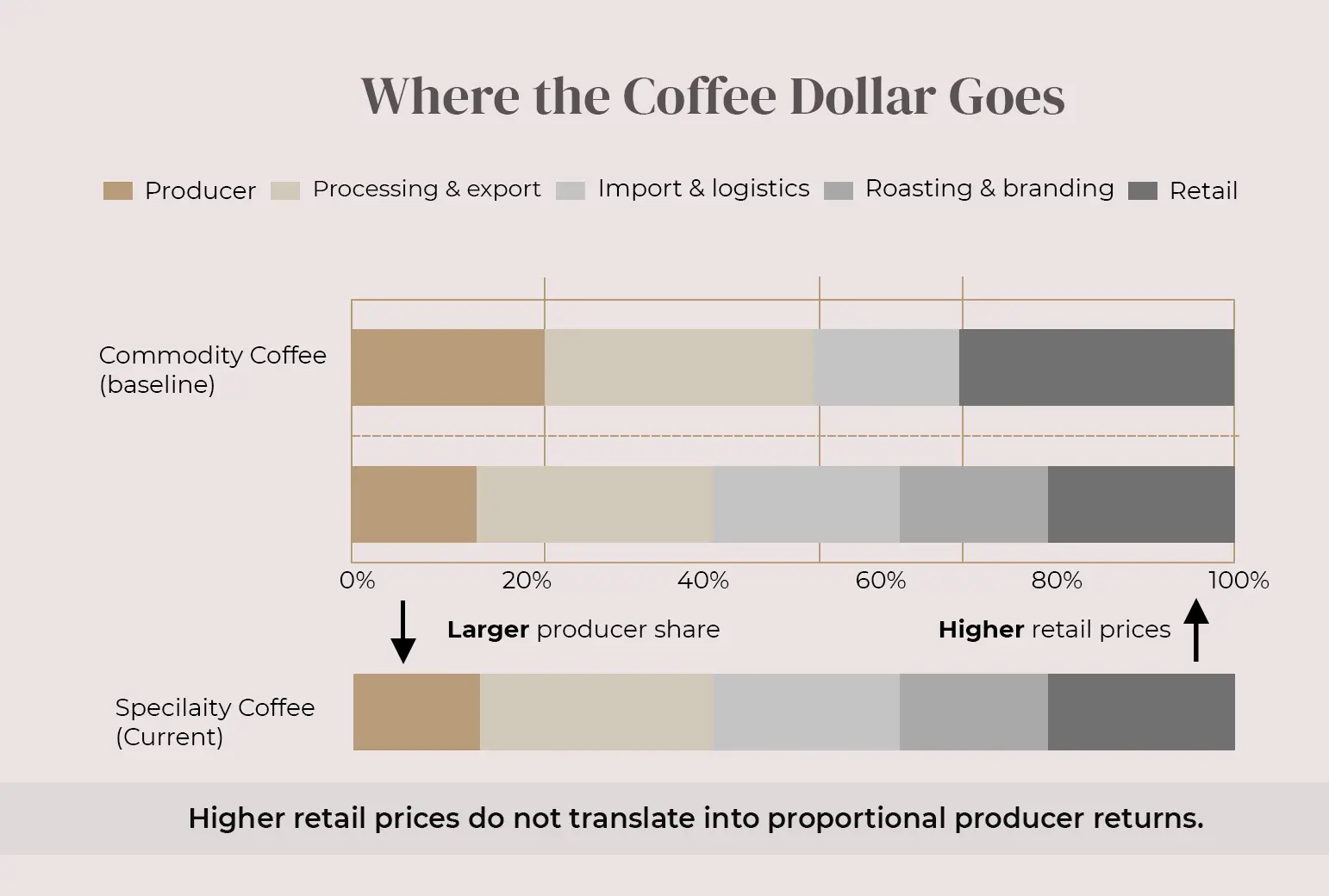
This shift toward premiumization raises an obvious question: where does the additional value actually go?
Price formation and bargaining power
Even though many specialty deals happen above the C market, reference prices still guide negotiations. Premiums are often seen as extras, not based on actual costs. This means producers still face price swings, even when retail prices go up.
Downstream concentration of value
Roasting, branding, marketing, and the retail experience now make up a bigger part of where value is created. Producers provide the key ingredient but rarely have a say in pricing or how profits are shared.
This leads to a situation where:
- Retail prices rise without corresponding increases in farmgate prices.
- Branding and storytelling capture disproportionate value downstream.
- Quality compliance is rewarded, but downstream value creation is not shared.
Uneven risk distribution
Premium markets often keep things stable for buyers by pushing uncertainty onto producers. Farmers invest in better quality, but buyers can still change how much they buy or where they buy from. This means most of the risk stays with the producers.
Transparency without redistribution
Greater visibility does not necessarily alter control. Producers may be named and visible, but pricing authority often remains unchanged. Transparency improves awareness without guaranteeing equity.
Read more: The Future of Coffee: Trends, Challenges, and Sustainable Solutions
Why Higher Coffee Prices Don’t Always Reach Producers
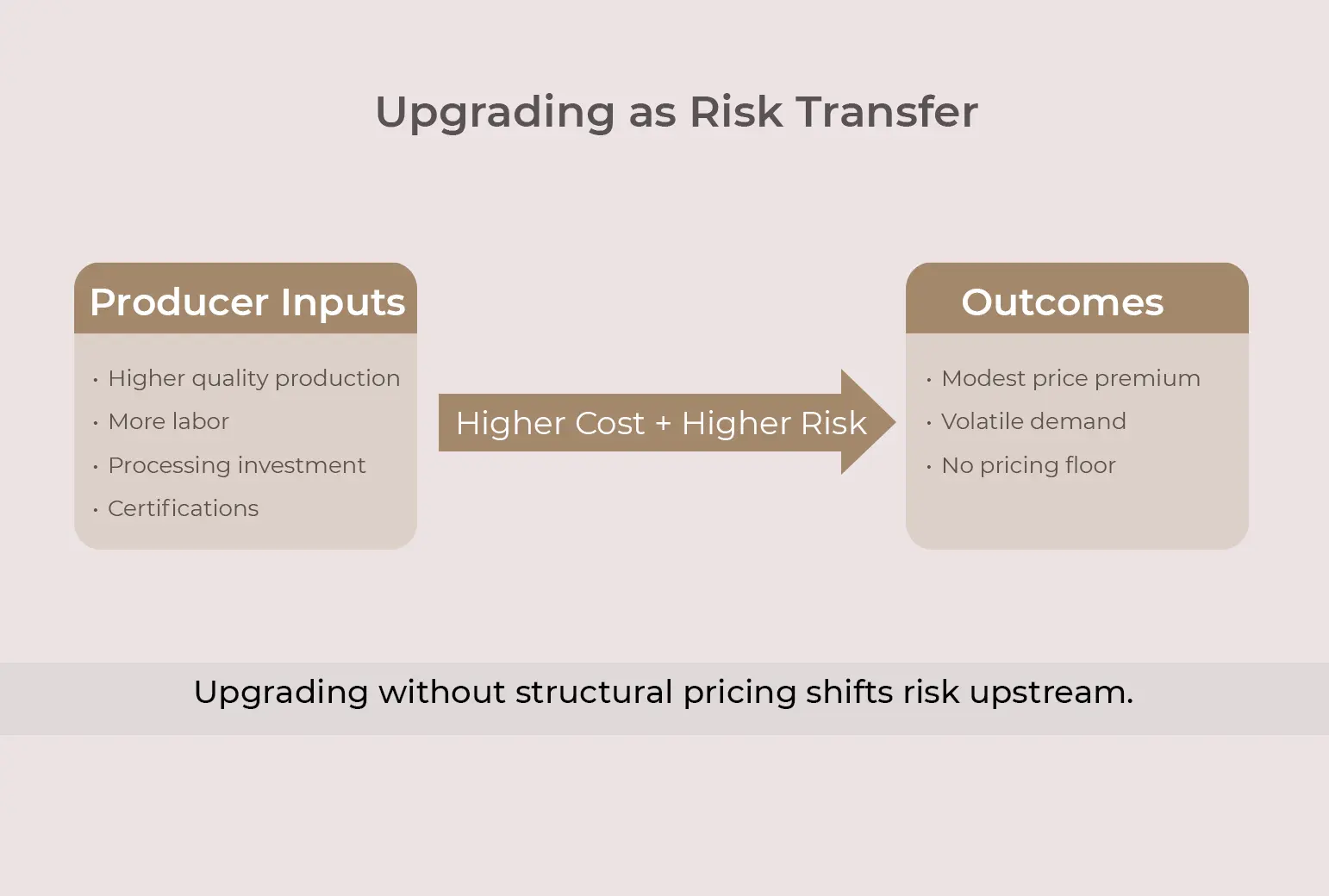
Upgrading is a logical response to premium markets. It means more labor, better processing, and more technical work. But these steps also raise costs and risks.
Prices, however, remain variable. Premiums fluctuate, compress, or are absorbed by intermediaries. Producers have to invest before they know whether they'll be paid back, while buyers keep their options open.
As more producers meet specialty standards, upgrading becomes a baseline requirement rather than a differentiator. Access improves, but income stability does not.
Addressing this imbalance requires models that intervene directly in pricing relationships.
What This Means for Producers at Origin
For producers, the effects of premiumization and upgrading are real. They show up in cash flow problems, trouble covering costs, and planning uncertainty.
Coffee producers must make significant upfront investments to participate in specialty markets. They absorb peak labor costs during harvest, maintain processing infrastructure year-round, and pay for inputs such as fertilizer, water, and energy long before coffee is sold. In premiumized markets, producers also shoulder rising costs as quality expectations increase.
Even when producers sell to specialty markets, they often get paid months after harvest—sometimes after export, after quality checks, or in installments. Premiums, if they exist, aren't always guaranteed when costs come up—this gap between spending and getting paid puts constant pressure on producers' cash flow.
Read more: The Hidden Cost of “Better Coffee”: Who Pays for Quality in 2026?
Upgrading intensifies this dynamic. To meet higher quality standards, producers adopt more selective harvesting, slower processing, and tighter quality control. These choices improve cup quality but reduce operational flexibility, and once producers commit resources, they cannot easily reverse those investments if market conditions change.
This creates several structural challenges for producers:
- Costs are fixed or rising, while prices remain variable.
- Income depends on the buyer's follow-through rather than production effort alone.
- Planning beyond a single harvest becomes difficult without price visibility.
- Risk accumulates at the farm level rather than being shared across the chain.
This context helps explain why producer vulnerability persists even as specialty coffee continues to command higher prices downstream. The issue is not a lack of quality or effort, but a mismatch between production economics and market structure.
When Specialty Coffee Does Benefit Farmers
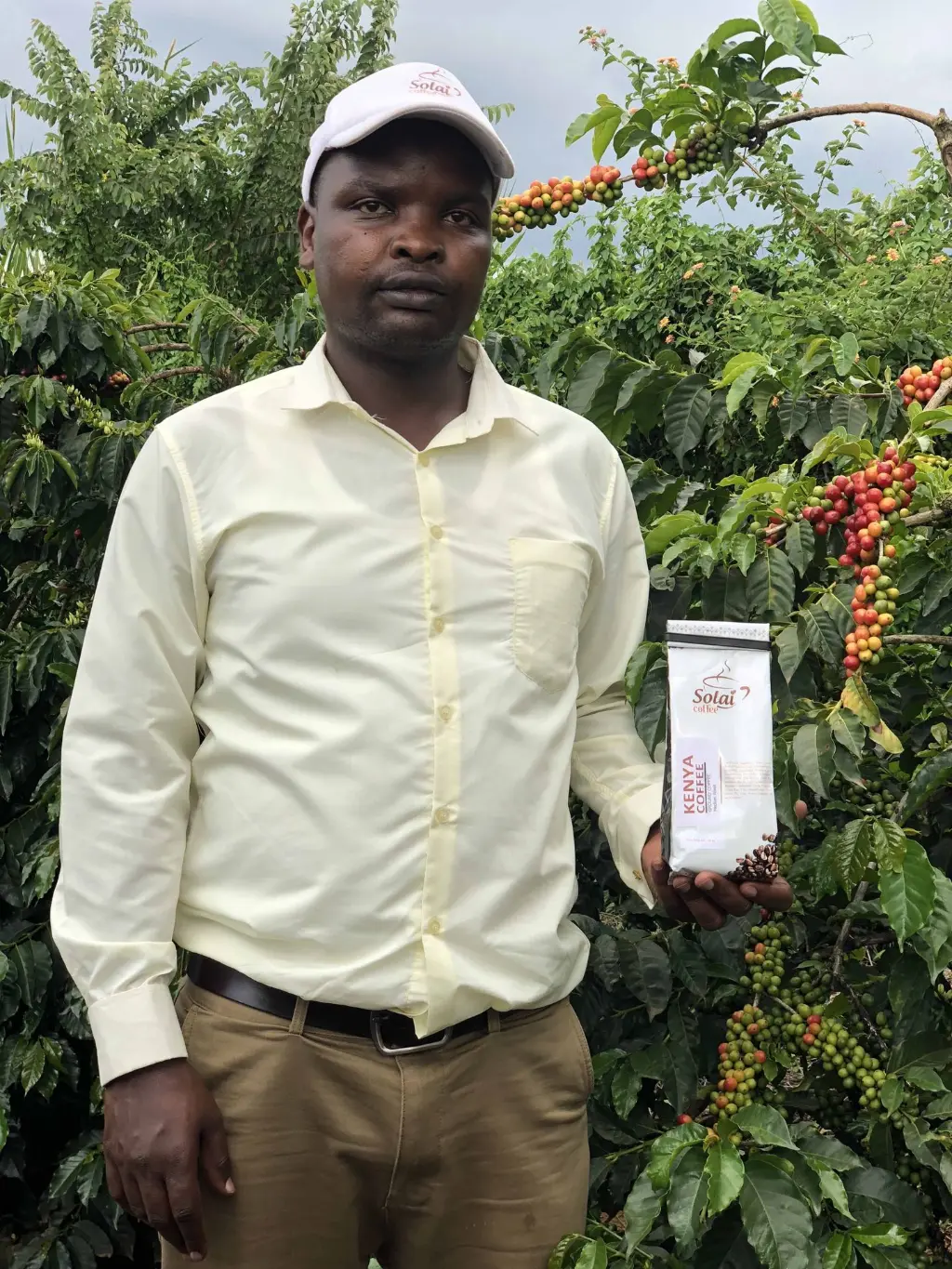
Farm-direct sourcing steps in where there are problems with pricing and bargaining power. It treats price as something to be negotiated based on real production costs.
Under farm-direct models, pricing discussions incorporate:
- Labor and input costs
- Infrastructure investment
- Climate risk and yield variability
- Long-term consistency
Risk is shared more fairly through more transparent pricing and longer-term agreements. Without intermediaries, more value goes to the producers without raising prices for consumers.
Farm-direct sourcing also increases the cost of exit, encouraging stability and alignment between quality expectations and compensation.
What Needs to Change for Farmers to Earn More
Kenya is a clear example of understanding the limits of premiumization.
Kenyan coffee is widely recognized for its quality. Structured grading systems, centralized washing stations, and meticulous processing standards have positioned Kenya as a flagship origin within specialty coffee. The beans often command substantial reputational premiums and feature prominently in high-end offerings.
Yet farmer income outcomes in Kenya remain inconsistent.
Much of this tension stems from how value flows through the Kenyan supply chain. Many smallholder farmers deliver cherries to cooperative or factory systems where pricing is determined well after delivery. Payments are often delayed, fragmented, and dependent on export performance rather than farm-level costs. Even when export prices are strong, the share that reaches farmers can vary significantly.
High standards are embedded in the system, and farmers must meet them to participate. This means that quality-related costs are incurred as a baseline requirement, not as a pathway to differentiation.
Premiumization amplifies this contradiction. Kenyan coffee may sell at high prices internationally, but the mechanisms that translate those prices into farmgate income are indirect. By the time value passes through processing, export, financing, and administrative layers, the link between retail price and farmer compensation becomes opaque.
These dynamics mirror the broader challenges identified throughout this article:
- Strong quality reputation does not guarantee pricing power at the origin.
- High standards increase costs without stabilizing returns.
- Delayed payments intensify cash flow pressure for farmers.
- Premiums are vulnerable to compression before they reach producers.
This is why alternative sourcing models have gained traction in Kenya, particularly among buyers seeking greater transparency and predictability. Farm-direct relationships allow pricing discussions to align more closely with production realities, shorten payment timelines, and reduce the distance between value creation and value capture.
So, Is Specialty Coffee Really Helping Farmers?
Specialty coffee has expanded quality, awareness, and price tolerance. What it has not consistently done is realign value and risk.
The evidence shows a system that is evolving under constraint. Growth now comes from premiumization, not volume. Upgrading improves access but increases exposure. Premiumization raises prices without correcting the imbalance.
Farm-direct sourcing is a practical solution. By changing how prices are set and how risk is shared, it tackles problems that branding alone can't fix.
The future of specialty coffee will depend more on how value is shared than on market growth.
If you want to support a coffee system that combines quality with fair pay, check out Solai Coffee options.
Whether you choose specialty green coffee or roasted beans, every purchase helps support intentional sourcing.