
A washed Kenyan AA or a PB in the hopper is a promise. Blackcurrant, citrus, florals, a syrupy body — these are the notes coffee farmers in Solai spend a year coaxing out of the cherry. And then, in roughly 28 seconds, your mobile espresso equipment either delivers that promise to the cup or flattens it into something generic.
If you run a coffee cart, a pop-up at a farmers' market, or a small café serving single-origin beans from partners like Solai Coffee's farmer-owned estates in Kenya, the espresso machine and grinder you pick will do more to shape your customers' experience than your branding, your menu design, or your milk choice. A clumsy thermal profile and a poorly chosen grinder can erase the floral top notes of a Kenya Peaberry before the cappuccino even reaches the lid.
This guide is for B2B partners — the wholesale café buyers, mobile cart operators, and roasters who are serious about honoring the bean they paid a premium for. We'll cover the four equipment decisions that make or break single-origin espresso service on the road: thermal stability, grinder geometry, water and power realities, and workflow ergonomics.
At Solai Coffee, we have seen both sides. We wholesale to cafés and roasters through our direct-trade wholesale program, and we also run Solai Coffee on Wheels, our own Orlando-based mobile espresso cart that pops up every weekend in Thornton Park. The equipment principles below are based on what we've had to figure out the hard way.
Quick Answer: The Four Equipment Decisions That Matter Most
For mobile espresso setups serving single-origin specialty coffee, prioritize equipment in this order:
- Thermal stability first. A dual-boiler or heat-exchanger machine (not a single-boiler) is non-negotiable for light-roast African coffees.
- Flat-burr grinder second. Flat burrs produce the unimodal grind distribution needed to express clarity in washed Kenyans and Ethiopians.
- 110V power with 20-amp capability third. Let you plug into almost any venue without having to beg for a 220V line.
- Water filtration fourth. A reservoir machine with proper in-line filtration or pre-treated water — not tap water straight from a hose.
Get these four right and your coffee will taste the same in a tent at a farmers' market as it would in a flagship café on Oxford Street. Get them wrong, and it won't matter how ethically the beans were sourced.
Why Single-Origin Kenyan Coffees Punish Bad Equipment
Commodity blends forgive mistakes. Dark-roast Brazil-heavy blends have low-and-slow flavor compounds — chocolate, nut, caramel — that survive temperature swings, channeling, and mediocre grinders. You can pull a drinkable shot from them on almost anything.
Washed Kenyans do not forgive. Solai coffee Amani and Amaya blend (Kenya AA+AB) is graded at a cupping score of 85, with a profile of black currant, citrus, floral aromatics, and caramel sweetness. The Precious Beans (PB) scores similarly and delivers a denser, more concentrated version of those same bright, tangy, fruit-forward notes. Those flavors live in volatile aromatic compounds that are destroyed by heat spikes, uneven extraction, and excessive fines.
In practice, that means the margin for equipment error on a Kenya AA is roughly three to four seconds of unstable brew temperature or a handful of extra micro-fines in the puck. Beyond that, the fruit note you paid $20+ per pound to serve vanishes. What's left is "a coffee" — not the coffee.
This is why the conversation around the journey from Kenyan farm to cup has to include the final ten feet of that journey: the machine and grinder on your cart.
Thermal Stability: The Single Most Important Spec
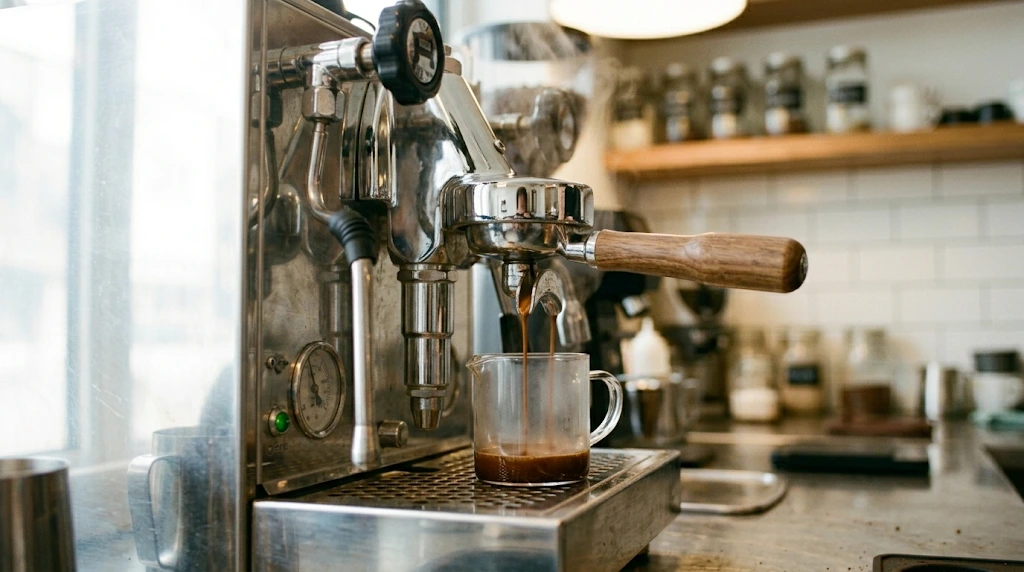
Steady brew temperature across
the 25–32 second extraction window is one of the most reliable predictors of
clarity in light-roast single-origin coffees.
Brew temperature defines which flavor compounds are extracted and which are left behind. For light-roast African coffees, the target range is typically 200–205°F (93–96°C), held steady throughout the full 25–32-second shot.
There are three thermal architectures you'll encounter. Only two belong on a specialty cart:
Single-boiler machines (avoid for specialty work)
One boiler heats water for both brewing and steaming, at different temperatures. To pull a shot after steaming milk, you have to "temperature surf" — wait for the boiler to cool, flush water, time your pull. In a farmers' market rush with a line six deep, this is a disaster. More importantly, temperature surfing is inherently imprecise, and a Kenya AA will taste stewed or sour depending on which side of the target temperature you land on. Fine for home hobbyists. Not acceptable for wholesale-quality service.
Heat-exchanger (HX) machines — the pragmatic cart choice
HX designs route cold brew water through a tube that passes through the steam boiler, heating it to brew temperature on the way to the group head. Thermosiphon circulation in models like the Rocket Appartamento or Profitec Pro 500 keeps the group head warm between shots. The Nuova Simonelli Oscar II is the classic cart HX workhorse — 110V, compact footprint, forgiving of the abuse that comes with mobile service.
Pros: one boiler, simpler plumbing, usually 110V-compatible, strong steam, affordable. Cons: you may still need a brief "cooling flush" before the first shot, and HX machines are slightly less thermally precise than dual boilers.
Dual-boiler machines — the specialty choice
Two independent boilers: one for brewing, one for steaming. Each holds its target temperature within tight tolerances (±1°F on machines with PID control). For single-origin espresso on a cart, the La Marzocco Linea Mini is the benchmark — a 3.5L steam boiler, commercial-grade rotary pump, and the thermal consistency of a flagship café machine in a single-group footprint. The Lucca A53 Direct Plumb and La Spaziale S2 Vivaldi are other well-regarded 110V dual-boiler options for serious mobile operations.
Expect to invest $3,000–$6,500. For wholesale-quality specialty service, it's the honest price of not wasting the farmer's work.

The Grinder Nobody Budgets Enough For
The single most common mistake mobile operators make is spending $4,000 on an espresso machine and pairing it with a $500 grinder. For single-origin specialty work, the ratio should be closer to 60/40 — machine to grinder — not 85/15.
The grinder is where flavor clarity is made or destroyed. Here's the short version of the science.
Flat burrs vs. conical burrs: why it matters for Kenyans
Flat burrs are two parallel steel discs with cutting edges facing each other. Coffee is cut into a narrow, unimodal particle distribution — most particles are nearly the same size. Conical burrs use a cone-shaped inner burr rotating inside a ring burr, producing a bimodal distribution — a wider range of particle sizes, with more fines.
For a light-roast Kenyan, this difference is decisive. As Mahlkönig's engineering team explains, flat burrs' particle uniformity means particles extract "as a team," producing a clean, transparent cup that highlights acidity, florals, and fruit. Conical burrs produce a bigger-bodied, sweeter, rounder shot — beautiful for a chocolatey Brazilian. Still, it muffles the blackcurrant clarity that makes a Kenya AA worth paying for in the first place.
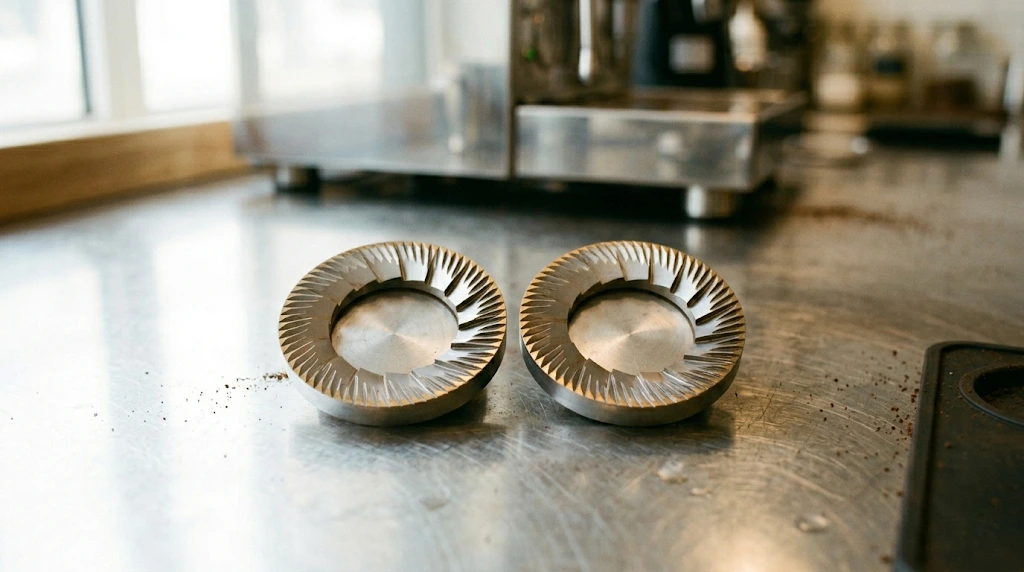
Flat burrs produce a narrower
particle size distribution, which tends to support the bright, articulate cup
that washed single-origins are known for.
Specialty-grade flat-burr grinders worth considering for a cart:
- Mahlkönig E65S / E80 Supreme — commercial flat burrs with electronic dose control. The gold standard for café-quality single-origin work.
- Nuova Simonelli Mythos 2 — 75mm flat burrs; considered one of the best espresso grinders ever made. Overkill for some carts; perfect for high-volume specialty.
- Eureka Atom 75 — 75mm flat burrs in a smaller footprint. A common pairing with the Lucca A53 in turnkey cart setups.
- Mahlkönig X54 — home/prosumer flat burr at a cart-friendly price point, suitable for low-to-mid-volume pop-ups.
For a more in-depth look at grinder pairings with commercial machines, see our guide to the best commercial espresso machines on Time for Espresso.
Power, Water, and the Physical Reality of a Coffee Cart
A machine that's perfect in a café can be useless at a farmers' market. As Prima Coffee's equipment team notes, the two make-or-break physical constraints for mobile setups are electrical and plumbing.
110V vs. 220V
Most US venues — farmers' markets, street fairs, pop-ups, weddings — give you a standard 110V outlet on a 15- or 20-amp circuit. A 220V machine means you're carrying a generator or negotiating with an electrician on site every time. Pick a 110V machine with 20-amp capability if at all possible. It's not about the ceiling; it's about never being locked out of a venue.
A related constraint: machine, grinder, Flojet pump, and any milk fridge often share one circuit. Draw a quick amp budget before you buy anything.
Reservoir vs. plumbed
A plumbed machine is faster and requires no babysitting. A reservoir machine is more flexible — you fill it from a sealed water jug and go. For most mobile operators, a machine that can do both (reservoir with an optional direct-plumb kit) is ideal. The Lucca A53 and Nuova Simonelli Oscar II both offer this.
Water chemistry (the part nobody talks about)
Brew water is over 98% of your espresso by weight. Tap water in most US cities is too hard, too alkaline, or too soft to extract specialty coffee properly. For Kenyan single-origin beans in particular, overly alkaline water will buffer out the very acidity that makes the coffee distinctive.
Ideal brew water has a calcium hardness of 50–175 ppm and an alkalinity of 40–70 ppm. Practical solutions for a cart: (1) carry pre-mixed water using Third Wave Water or similar sachets added to distilled water; (2) run an RO or softening cartridge before the reservoir; (3) use BWT bestmax or Everpure in-line filters matched to your municipal water profile.
Workflow: The Hidden Equipment Decision
Equipment isn't just about specs — it's about how fast and consistently your barista can work under pressure. A line of 12 customers at a Sunday farmers' market is not the context for troubleshooting.
Volumetric or timed dosing
Look for machines with volumetric controls or a built-in shot timer. On a busy cart, hands-off shot timing lets the barista focus on milk texture and customer service simultaneously. The Nuova Simonelli Musica and Appia Life Compact both offer volumetric programming in a 110V footprint.
Steam capacity
For a specialty cart serving mostly cortados, flat whites, and 8 oz cappuccinos, a 1.5–2L steam boiler is typically sufficient. For high-volume service with 12-16 oz milk drinks, you want 3L+ (the Linea Mini's 3.5L is a benchmark). Undersized steam boilers will drop pressure during rushes — and a lukewarm, under-textured milk drink erases all the upstream work on bean quality and thermal stability.
Footprint and ergonomics
Measure your cart workspace twice. A single-group machine typically has a 15" × 20" footprint. Add the grinder (another 9" × 15"), knock box, tamping station, milk pitchers, syrup bottles, and customer pickup zone. Most first-time cart operators underestimate workspace by 40%.
A Sample B2B Setup for Single-Origin Specialty Service
Here's a realistic equipment stack for a café or mobile operator who's committed to showcasing single-origin Kenyan or Ethiopian beans on a cart.

This isn't a minimum viable setup — it's a respect-the-bean setup. If the beans in your hopper cost less than $12/lb wholesale, the entry tier is more than enough. If you're pouring $20+/lb single-origins from Kenya, Ethiopia, or Panama, the serious tier pays for itself in customer retention.
Frequently asked questions
Technically, yes; practically, no. A prosumer machine like the Rocket Appartamento or Profitec Pro 500 can pull 15–25 drinks per hour, which is fine for a low-volume pop-up. But these machines weren't designed for 6-hour farmers' market shifts with back-to-back milk drinks. Their steam boilers will struggle, and the pump duty cycle isn't rated for continuous commercial use. If you expect more than 30 drinks per hour, you want a purpose-built commercial or commercial-hybrid machine.
For Kenyan, Ethiopian, Panamanian, or other light-roast African and Latin American single-origins, yes — flat burrs deliver the particle uniformity that lets those delicate floral and fruit notes come through in the cup. A high-end conical like the Mazzer Philos or a Niche Zero can also produce excellent results, particularly if your menu leans toward bigger-bodied, chocolate-forward single-origins. But for bright, acidic profiles, a flat burr grinder is the safer bet.
A serviceable 110V single-group HX machine plus a specialty flat-burr grinder starts around $4,500–$5,500. A dual-boiler specialty-grade setup runs $8,000–$12,000. Water filtration, scales, tampers, knock boxes, and cart structure add another $1,500–$3,000—realistic all-in: $7,000 on the low end, $15,000 for a fully dialed specialty cart.
The Specialty Coffee Association recommends a total hardness of 50–175 ppm CaCO3 and an alkalinity of 40–70 ppm. Most US tap water falls outside this range, which is why pre-treated water or in-line filtration is non-negotiable for specialty work.
For new operators under two years in business, leasing or buying used can preserve cash and let you upgrade as your service volume grows. Many established specialty machines — particularly Nuova Simonelli and La Marzocco — retain strong resale value. Used Linea Minis and Oscar IIs are frequently available in the $2,000–$4,500 range on home-barista forums and specialty dealers.
Three habits make the biggest difference: (1) store beans sealed and opaque — sunlight and heat on a cart dash will stale a Kenya AA in hours; (2) purge the group head and do a test shot at the start of each event to recalibrate; (3) keep water volume in your reservoir consistent, since a near-empty reservoir heats unevenly.
Closing the Loop: Equipment That Honors the Farmer's Work
The farmers at Liwani Estate and Wagika Farm — and their counterparts across Kenya's coffee-growing highlands — work with precision. Soil pH, altitude, shade cover, cherry selection, washing protocols, drying times — every variable is tuned to produce a cup with the clarity and brightness that Kenyan specialty coffee is known for globally.
Mobile baristas are the last mile of that precision chain. A cart operator running a single-boiler machine and a cheap conical grinder is breaking that chain — regardless of how ethically the beans were sourced or how well they were roasted. Conversely, an operator pairing a dual-boiler or quality HX machine with a flat-burr specialty grinder, filtered water, and consistent workflow is carrying the farmer's work all the way to the customer's cup.
If you're a café, roaster, or cart operator looking to source single-origin Kenyan beans that deserve this level of equipment, explore Solai's farm-direct wholesale program. If you're curious how the cart model works in practice, see how Solai runs Coffee on Wheels at Orlando pop-ups. The goal, in both cases, is the same: respect the bean from farm to cart, and let the cup speak for itself.
Further reading from Solai Coffee
- The Journey of a Coffee Bean: From Kenyan Farms to Your Cup
- Empowering Women in Coffee: Driving Change Across the Value Chain
- Meet the Farmers Behind Solai's Kenyan Specialty Coffee
Author Bio

Alberto Walker
Alberto Walker is the founder and lead writer at Time for Espresso, where he publishes data-driven reviews and technical guides for home and commercial espresso. His work focuses on the mechanics behind a great shot — thermal stability, grind consistency, water quality, and the equipment choices that bring single-origin coffees to life. When he's not testing gear, he's chasing well-extracted shots and writing about why the small details matter.